Your phone starts the conversation. Two switches stop it.
Two iOS settings — Raise to Wake and Tap or Swipe to Wake — let your phone light up before you decide to look. Here's what the attention and parenting research says, and how to flip both off tonight.

It's 7:42am. The kid is on the counter stool. The oatmeal is in the microwave. Your phone is face-up next to the fruit bowl, doing nothing — until the counter takes a small bump as your kid reaches for a spoon, and the screen lights up on its own. Two seconds of glow. A small hand goes toward it. It's locked, nothing opens. But the reach happened. Your eyes went to it too.
That small moment repeats maybe fifty times in a day, in different rooms, in different combinations of hand and hip and pocket and table. Some of those times the reach turns into a check. Some of the checks turn into fifteen minutes. And you did not really decide any of it.
There is one small thing you can change tonight, once, that removes almost all of those moments. It doesn't restrict anyone. It doesn't count anything. It just stops the phone from starting the conversation.
What the phone does before you touch it
Two iPhone settings, both on by default, hand your phone a lot more agency than you might realize. Raise to Wake turns the screen on when you pick the phone up or tilt it. Tap or Swipe to Wake turns it on when a fingertip — or a sleeve, or the corner of a book, or a child's palm — brushes the display. Together they mean the screen is willing to light itself. It does not need you to press a button. It does not need you to decide.
That distinction matters more than it looks. Researchers have spent the last decade measuring what happens when a phone becomes visually salient in the middle of doing something else — even without a notification, even without you touching it. Skowronek and colleagues, in a 2023 experiment published in Scientific Reports, had adults do a standard concentration task twice: once with the phone on the desk, once with it removed from the room. Both average attention performance and processing speed came out significantly lower when the phone was present — and the phone was silent and powered off. [1] The device did nothing. It sat there. That was enough.
A larger, causal test came in 2025. A preregistered randomized trial from Castelo, Kushlev, Ward and colleagues, published in PNAS Nexus, asked 467 adults to disable mobile internet on their smartphones for two weeks. Sustained attention improved to a level the authors described as equivalent to being about ten years younger cognitively, and 91% of participants improved on at least one of the trial's attention, mental-health, or well-being measures. [2]
Nobody is asking you to switch off your internet. That's a high-effort experiment. But it tells you something useful about the very low-effort version: most of what the phone costs you cognitively is not the app. It's the availability of the app. The lit screen is the availability made visible. Every unrequested glow is a small tap on the shoulder — and your attention answers whether or not you'd meant to.
The light itself is the reward
Now the second audience in your kitchen. When a phone lights up because a small hand grazed it, something specific is being learned. Behaviourists have a name for a reward that arrives on an unpredictable schedule tied to your own action: variable-ratio reinforcement. It is the most durable form of learning we know how to install in a nervous system. Slot machines run on it. Notifications run on it. And a wake-on-touch screen runs on it before any app is ever opened.
A phone that lights up when touched teaches the smallest people in your house that touching the phone produces light. That is a whole game. It is a game you did not agree to install, and one that runs whether or not any app is ever opened. Take the light away and the game becomes far less interesting. A dark rectangle in a small hand does not have much to offer.
What lights up during family time
There is a growing body of experimental evidence on what a lit-up screen does to the adults in the room, too — specifically to the caregiving ones. Dinzinger and colleagues, in a 2025 Infancy study, ran 67 mothers and their six-month-old babies through a modified still-face paradigm. In the smartphone phase, the mother turned her attention to her device for two minutes. Infants showed more protest behavior, higher cardiac arousal, and reduced parasympathetic activity than at baseline. [3] Their small nervous systems noticed the mother going quiet toward a screen, and reacted the way infants react to any loss of a caregiver's face.
Zoom out and the picture holds at a population level. A 2025 meta-analysis in the Journal of Medical Internet Research pooled 53 studies and 60,555 participants on parental technoference — the everyday interruption of parent-child interaction by a device — and found a consistent positive association between parents' technoference and their children's own problematic media use (r = 0.296). [4] Children learn what devices are worth by watching whose face they take.
None of this is about being a bad parent. Nobody in the research is being judged. It's about a room where devices announce themselves, versus a room where they don't. A screen that only wakes on a deliberate press is a much quieter object. It stops asking for the room's eyes.
The two switches, done once tonight
You need ninety seconds. Then never again.
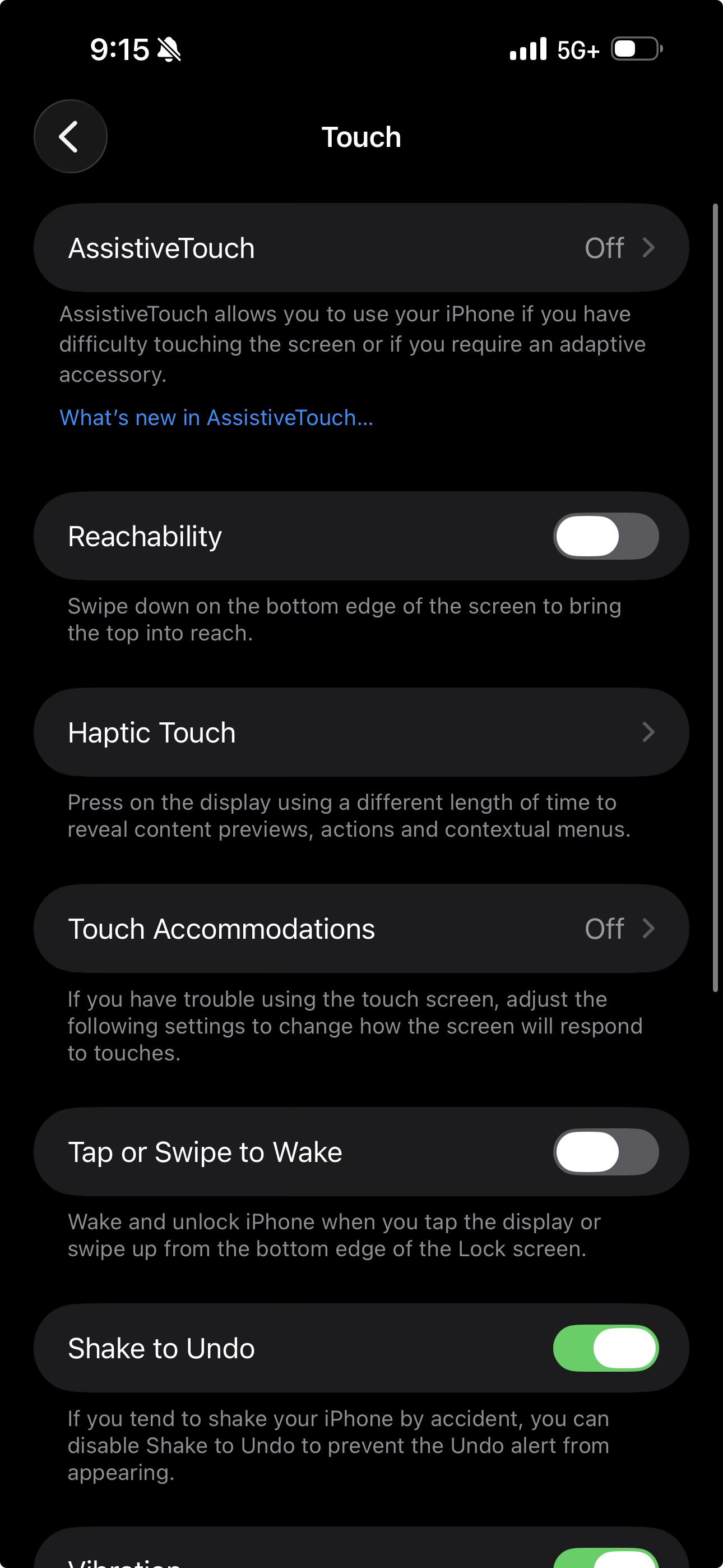
Open Settings → Accessibility → Touch. Scroll to Tap or Swipe to Wake. Turn it off. Now the display will not wake because a fingertip, a sleeve, or a small hand grazed the glass. It waits for you.
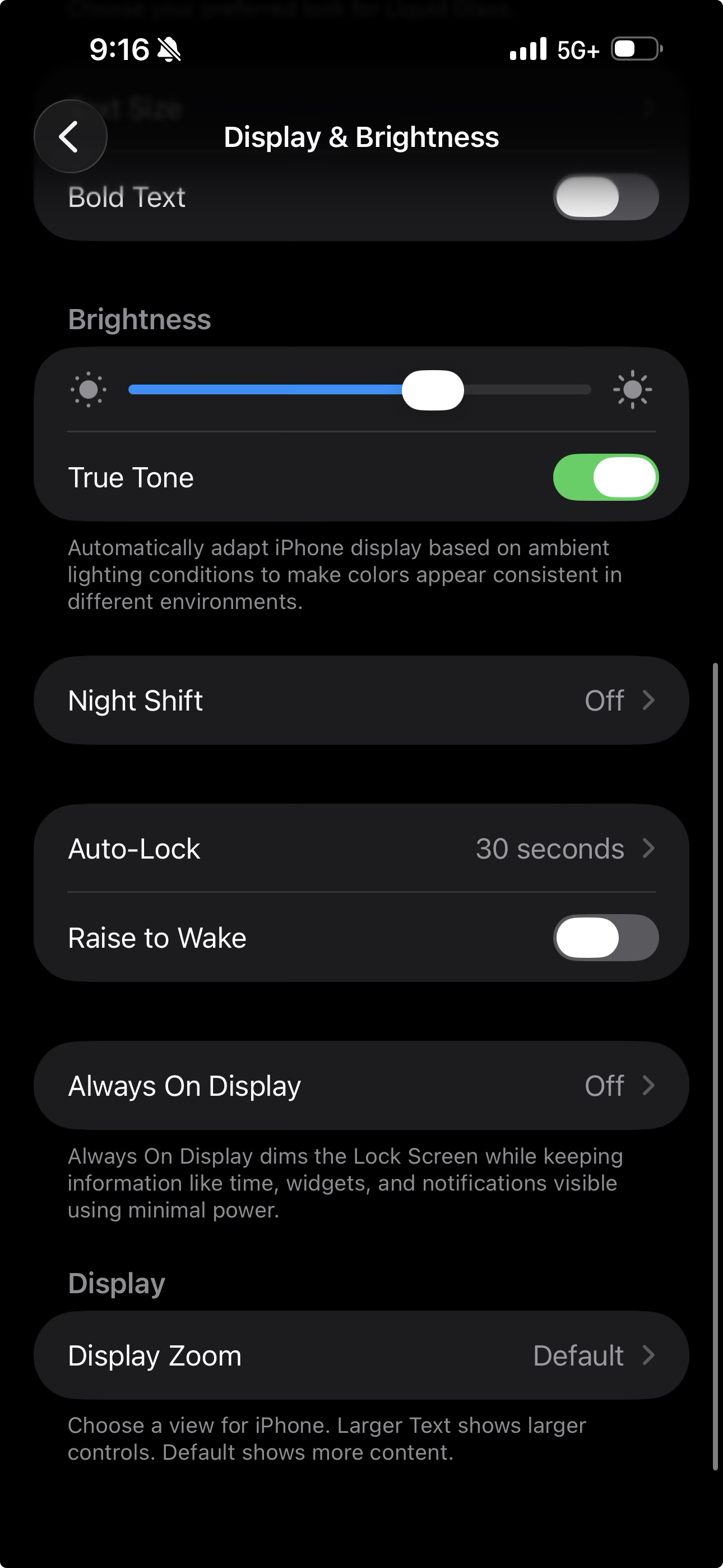
Open Settings → Display & Brightness. Turn Raise to Wake off. Now the phone will not light up when you pick it off the table, when you take it out of your pocket, when a kid lifts it off the counter. It waits for the side button.
While you're on that same screen, set Auto-Lock to 30 seconds. This one is the quiet partner to the other two: when you do put the phone down, it goes dark fast, so the class of moments we're talking about — screen briefly on, in the room, unattended — shrinks toward zero.
Two honest trade-offs. First, a quick glance at the time now costs a button press; if you rely on Always On Display, it becomes a two-step. Second, some people use Raise to Wake for hands-full accessibility reasons — a stroller, a wheelchair, a mobility difference. Both of those matter. Choose what fits your body and your life.
The small reframe
You are not restricting your phone. You are asking it to stop initiating. That is a different relationship — closer to the one you have with your kettle, or your front door. Things that do their thing when you turn them toward the world, and stay quiet the rest of the time.
Your evenings and your family time already have enough small announcements in them. Tonight, take ninety seconds. Flip two switches. Let your phone go back to being the thing you pick up, on purpose, when you're ready.
- The mere presence of a smartphone reduces basal attentional performanceSkowronek J, Seifert A, Lindberg S, Scientific Reports · 2023
- Blocking mobile internet on smartphones improves sustained attention, mental health, and subjective well-beingCastelo N, Kushlev K, Ward AF, Esterman M, Reiner PB, PNAS Nexus · 2025
- Tiny Screens, Big Impact: Effects of Maternal Smartphone Use on Maternal and Infants' Physiological and Behavioral Stress and Interaction DynamicsDinzinger A, et al., Infancy · 2025
- Parental Technoference and Child Problematic Media Use: Meta-AnalysisZhang J, Zhang Q, Xiao B, Cao Y, Chen Y, Li Y, Journal of Medical Internet Research · 2025

Set your rhythm.
Tempo is the sleep-first screen time app. Free to download. Works tonight.